These Miami residents choose to live without cars. It can be a challenge
Miami Herald
By Ashley Miznazi
This article originally appeared in the Miami Herald.
Driving in Miami-Dade is something that just about everyone will agree is frustrating — with bumper-to-bumper traffic jams, last-minute merges and inevitable road rage. Yet many residents would still rather spend nearly three full days a year stuck in traffic than take public transportation.
Most people who use public transit in Miami-Dade do it because they have to. But some choose it intentionally, aiming for a more sustainable lifestyle for both their health and the planet.
How you get around is one of the biggest decisions you make each day that affects the climate. Transportation is the largest source of climate-warming emissions in the United States, and a recent National Parks Conservation Association study found that cars in South Florida pump out as much pollution as 30 coal plants. Still, even the shortest trips are often taken by car.
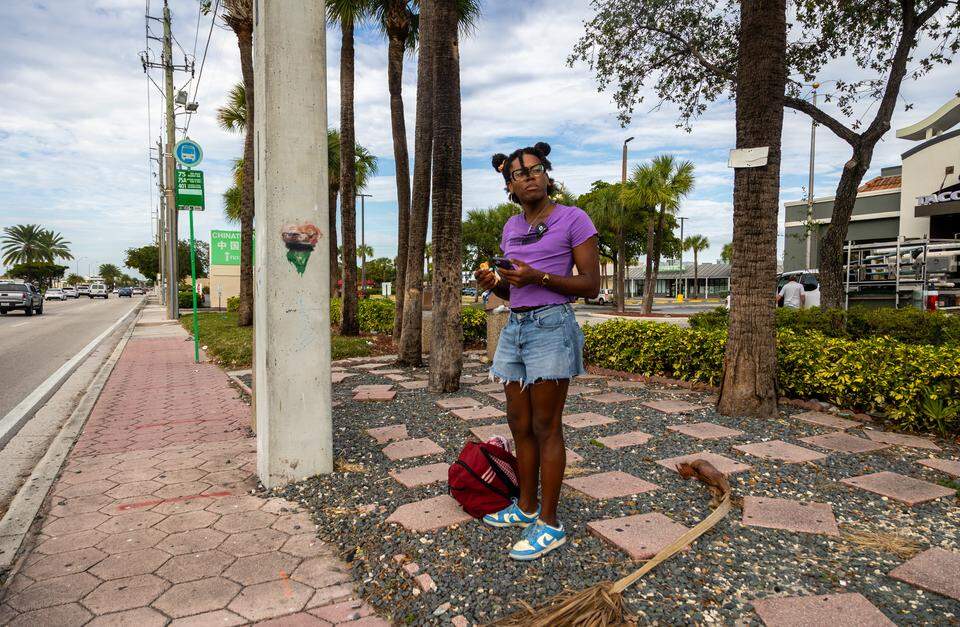
Z Spicer waits at the bus stop, a 15-minute walk from their house in North Miami.
Ashley Miznazi [email protected]
Z Spicer, a 25-year-old climate justice organizer for Catalyst Miami, is trying to shift that mindset.
They first dabbled in using transit a couple of years ago, to go to the skate park or government center. But since August, when their roommate crashed their shared car, it’s been a necessity.
Someone offered to sell Spicer a used electric car, but they ultimately turned it down.
“The more I’ve been taking the bus, I walk more, and I love the public transportation experience when it works. It’s nice to be out in my community, it slows me down,” Spicer said.
Spicer said that as a climate justice organizer, they want to model that the future they’re advocating for is possible. “I think part of that is showing that public transit, even though it’s not good in Miami-Dade, it’s here,” Spicer said.
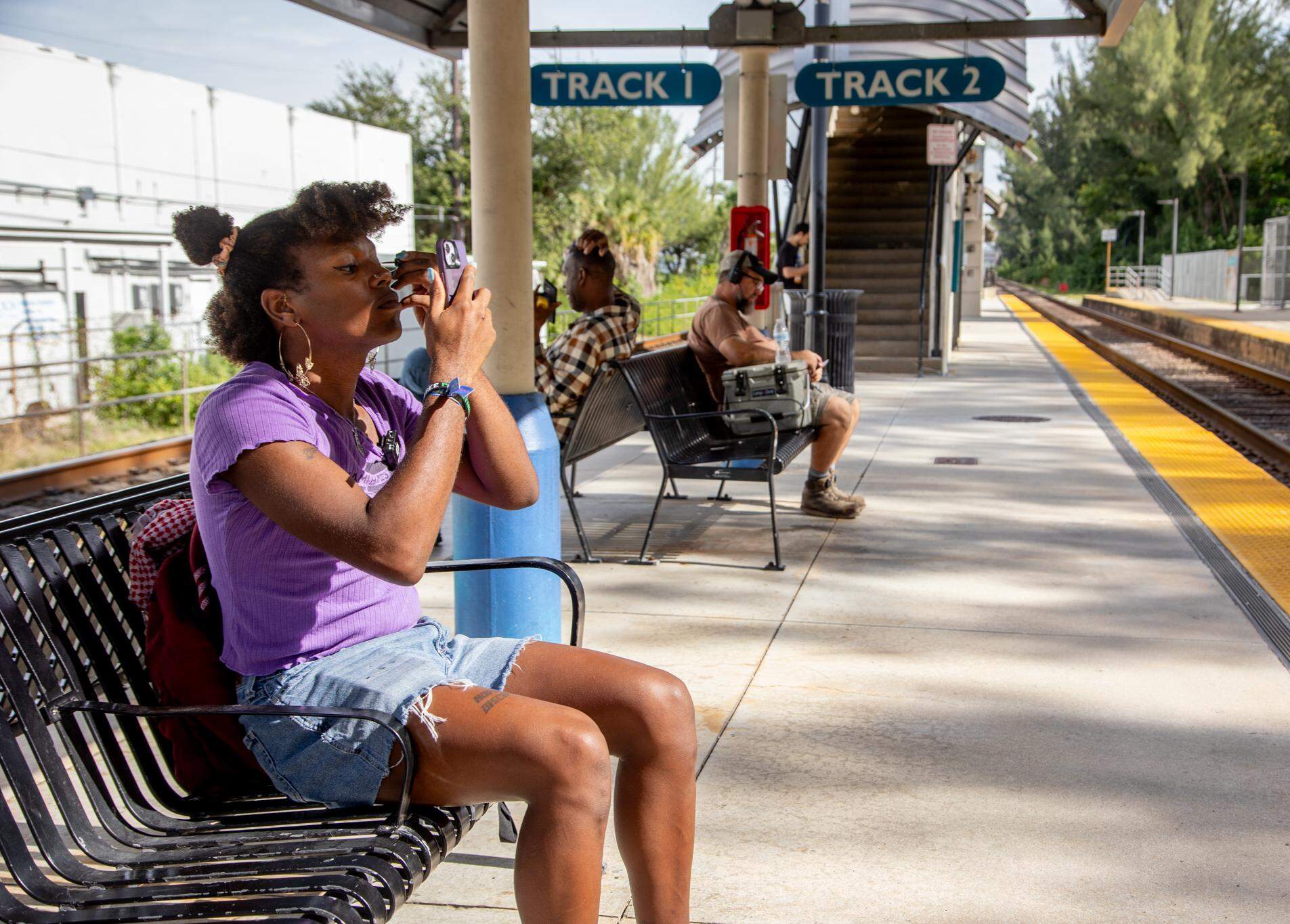
Z Spicer puts on eyeliner while waiting for the Tri-Rail as part of their commute to work in Little Havana.
Ashley Miznazi [email protected]
But for Spicer, the change has been a commitment.
Their commute from the Golden Glades neighborhood in North Miami to the Catalyst office in Miami is about 13 miles. It took Spicer two hours and 36 minutes. They took the bus from Sixth Avenue to the Tri-Rail, switched to Metrorail to get to UHealth Jackson, then caught another bus to Little Havana. By car, the same commute is about 42 minutes during rush hour.
Where you live makes the difference
Making the commitment to go carless is easier for people whose daily comings and goings cover less terrain and for those who live close to public transportation hubs.
Cathy Dos Santos, Executive Director of Transit Alliance Miami, said she purposefully picked living in South Beach because it was easier to access transit routes.
“Your neighborhood is a game changer on how you feel and how well this works for you,” Dos Santos said. She joined Transit Alliance, which advocates for reliable transit, out of frustration with using the transit system.
In her car-free lifestyle, she prefers taking the bus because it covers so much of the county. But it does come with its problems. Dos Santos’ bus came early on the day she took the Herald through her commute, which set her entire route behind. The journey usually takes 45 minutes, but that day her journey took over an hour and a half.

Cathy Dos Santos stands on the Omni Loop of the People Mover transport to the Government Center. Today her journey from home to her office took over an hour and a half using multiple modes of transit.
Carl Juste [email protected]
She has a few alternative routes too, “It all depends on how sweaty I’m willing to get that day,” she said.
Kenneth García and his family have been without a car for more than a decade. He and his wife bought their house in South Miami and were intentional about living near their places of work, children’s schools and other necessities, like a grocery store.
“I feel like I found a cheat code where I avoid traffic all together,” Kenneth García said. “It was really a quality of life decision more than anything. It’s a great way to get your exercise in without really thinking about it, and environmentally it's just a bonus like icing on the cake.”
Every morning, he loads his 5-year-old daughter, decked out in a hot pink helmet, into a seat on the back of his bike and drops her off at school before biking another 15 minutes to Dover, Kohl & Partners, where he works as a principal city planner designing more sustainable communities.
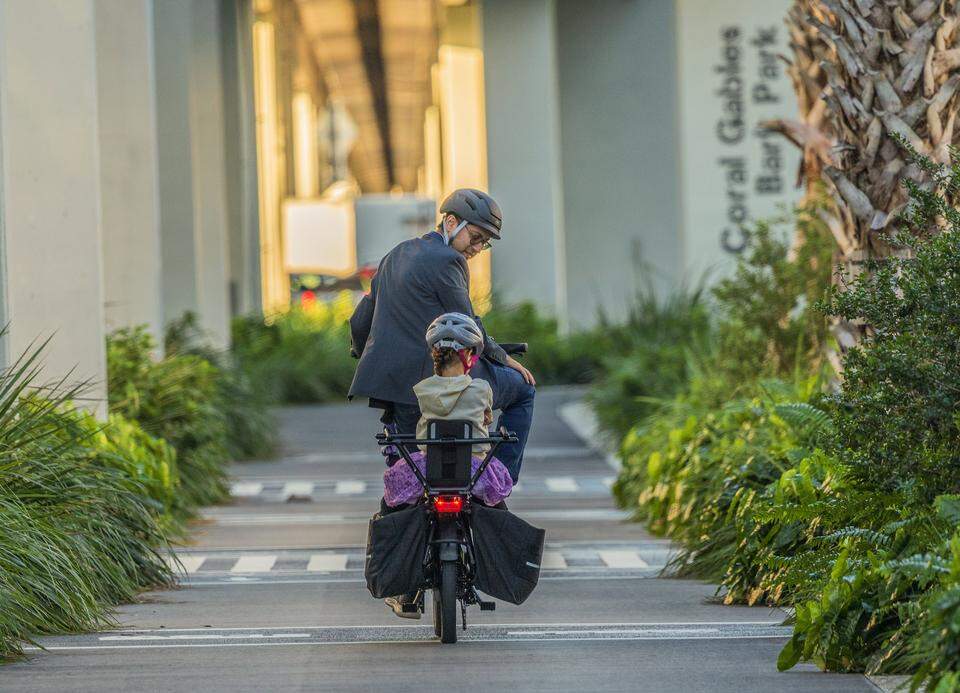
Kenneth Garcia, a Coral Gable resident, said he intentionally lives in an area where his home, work, children’s schools and amenities are nearby so he doesn’t have to own a car.
Pedro Portal [email protected]
Ready to save, but not ready to give up cars
The appetite to go carless in Miami is real.
A recent survey of 600 Miami voters conducted by Partnership for Miami found that 49 percent of respondents would strongly consider using transit instead of driving in a car if options were increased and improved. Everyone the Herald spoke to about using public transportation said saving money was one of the considerations for going car-free.
“In terms of CO2 emissions, transit makes a big difference. But also it’s not affordable to pay rent and then have a car with parking and insurance,” said Maria Claudia Schubert, a climate justice policy manager who works with Spicer at Catalyst.

Z Spicer and Maria Claudia Schubert, climate justice organizers at Catalyst, take the bus home together from work.
Ashley Miznazi [email protected]
Roughly 20 percent of what households spend in a year goes to getting around, according to data from the Bureau of Labor Statistics. Gas alone is about 4 percent of annual household spending in Miami, one of the highest shares among major U.S. metro areas, according to the Census Bureau.
García and his wife took the money they would’ve spent on a car payment, insurance and gas and instead invested it in an apartment in Coral Gables they rent out.
But as commuters do the mental math on going carless, public transit’s shortcomings can make the investment in a car seem worthwhile.
Miami-Dade County conducted a survey this year, asking more than 2,000 bus riders their top concerns last year. At the top of the list were unreliable schedules, concerns about discontinued routes and overcrowding.
“We’re constantly listening to our ridership and trying to tweak our services to meet their needs,” Stacy Miller, Miami-Dade County Transportation Director, said. “We’ve made several modifications for service routes based directly on ridership feedback.”
How to make transit better in a city built for cars
The short answer for how Miami got to be so car-dependent is suburban sprawl, experts say.
For decades planning has revolved around cars. South Florida still has walkable pockets like in South Beach and Coral Gables, but sprawling, car-centric development dominates.
“How do you address the fundamental infrastructure problem of everybody needing to get in their car, because it’s all laid out already,” Kenneth Garcia said.
Dover said it’s also in the way we continue to build.
“We can’t build our way out of these problems with highway capacity, but we can build our way out of the problem with neighborhoods,” he said.
That would mean apartments built closer to transit, putting more grocery stores near residential and “mixing land use” to work is closer to home.
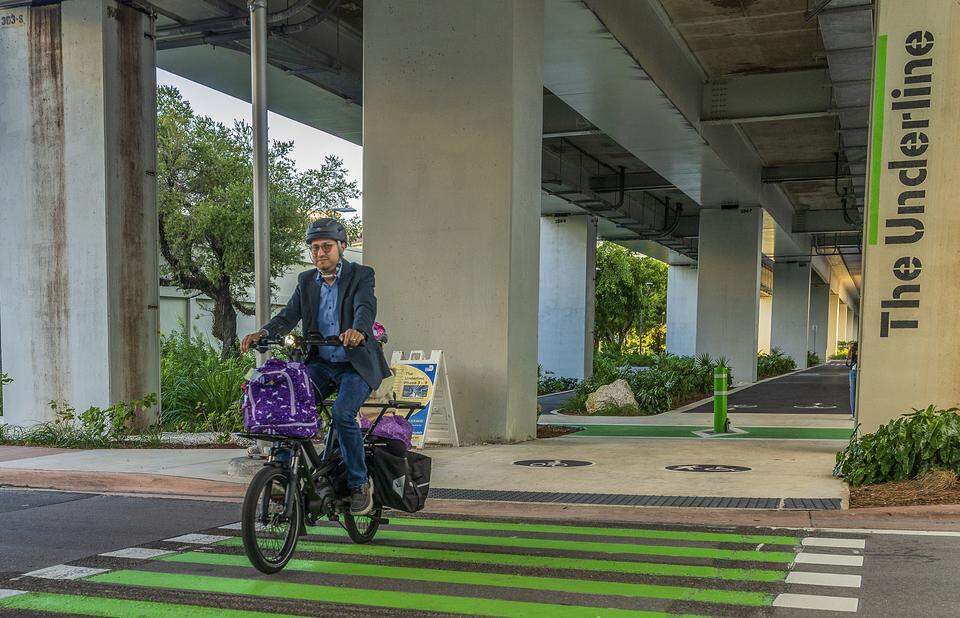
Kenneth Garcia takes his daughter to school riding his bike through The Underline in Coral Gables before heading to his work.
Pedro Portal [email protected]
The most transformative fix would be mass transit, but Tony Garcia, an architect and principal at Street Plans with no relation to Kenneth García, said it’s “phenomenally expensive in the United States.”
Miami-Dade has long discussed extending Metrorail to Miami Gardens, but rising costs have pushed the project further out of reach.
Transportation Director Stacy Miller said the county still hopes to build it, but must take “intermediate steps” first.
There have been some advancements, like the Underline and the Metro Express bus, which sped up routes and have air-conditioned waiting spaces to help beat the heat.
“Everybody is moving from the local service to the express, still about the same numbers, but now the goal is to increase that ridership,” Miller said.
Even going “car-light” and opting not to take the car on a trip that’s close on foot can collectively make a big difference.
For commuters like Dos Santos who are committed to going carless, the inconvenience of navigating public transit is worth it.
“I know this is the future I want to build,” said Dos Santos.
By Ashley Miznazi
This article originally appeared in the Miami Herald.
Driving in Miami-Dade is something that just about everyone will agree is frustrating — with bumper-to-bumper traffic jams, last-minute merges and inevitable road rage. Yet many residents would still rather spend nearly three full days a year stuck in traffic than take public transportation.
Most people who use public transit in Miami-Dade do it because they have to. But some choose it intentionally, aiming for a more sustainable lifestyle for both their health and the planet.
How you get around is one of the biggest decisions you make each day that affects the climate. Transportation is the largest source of climate-warming emissions in the United States, and a recent National Parks Conservation Association study found that cars in South Florida pump out as much pollution as 30 coal plants. Still, even the shortest trips are often taken by car.
Z Spicer waits at the bus stop, a 15-minute walk from their house in North Miami.
Ashley Miznazi [email protected]
Z Spicer, a 25-year-old climate justice organizer for Catalyst Miami, is trying to shift that mindset.
They first dabbled in using transit a couple of years ago, to go to the skate park or government center. But since August, when their roommate crashed their shared car, it’s been a necessity.
Someone offered to sell Spicer a used electric car, but they ultimately turned it down.
“The more I’ve been taking the bus, I walk more, and I love the public transportation experience when it works. It’s nice to be out in my community, it slows me down,” Spicer said.
Spicer said that as a climate justice organizer, they want to model that the future they’re advocating for is possible. “I think part of that is showing that public transit, even though it’s not good in Miami-Dade, it’s here,” Spicer said.
Z Spicer puts on eyeliner while waiting for the Tri-Rail as part of their commute to work in Little Havana.
Ashley Miznazi [email protected]
But for Spicer, the change has been a commitment.
Their commute from the Golden Glades neighborhood in North Miami to the Catalyst office in Miami is about 13 miles. It took Spicer two hours and 36 minutes. They took the bus from Sixth Avenue to the Tri-Rail, switched to Metrorail to get to UHealth Jackson, then caught another bus to Little Havana. By car, the same commute is about 42 minutes during rush hour.
Where you live makes the difference
Making the commitment to go carless is easier for people whose daily comings and goings cover less terrain and for those who live close to public transportation hubs.
Cathy Dos Santos, Executive Director of Transit Alliance Miami, said she purposefully picked living in South Beach because it was easier to access transit routes.
“Your neighborhood is a game changer on how you feel and how well this works for you,” Dos Santos said. She joined Transit Alliance, which advocates for reliable transit, out of frustration with using the transit system.
In her car-free lifestyle, she prefers taking the bus because it covers so much of the county. But it does come with its problems. Dos Santos’ bus came early on the day she took the Herald through her commute, which set her entire route behind. The journey usually takes 45 minutes, but that day her journey took over an hour and a half.
Cathy Dos Santos stands on the Omni Loop of the People Mover transport to the Government Center. Today her journey from home to her office took over an hour and a half using multiple modes of transit.
Carl Juste [email protected]
She has a few alternative routes too, “It all depends on how sweaty I’m willing to get that day,” she said.
Kenneth García and his family have been without a car for more than a decade. He and his wife bought their house in South Miami and were intentional about living near their places of work, children’s schools and other necessities, like a grocery store.
“I feel like I found a cheat code where I avoid traffic all together,” Kenneth García said. “It was really a quality of life decision more than anything. It’s a great way to get your exercise in without really thinking about it, and environmentally it's just a bonus like icing on the cake.”
Every morning, he loads his 5-year-old daughter, decked out in a hot pink helmet, into a seat on the back of his bike and drops her off at school before biking another 15 minutes to Dover, Kohl & Partners, where he works as a principal city planner designing more sustainable communities.
Kenneth Garcia, a Coral Gable resident, said he intentionally lives in an area where his home, work, children’s schools and amenities are nearby so he doesn’t have to own a car.
Pedro Portal [email protected]
Ready to save, but not ready to give up cars
The appetite to go carless in Miami is real.
A recent survey of 600 Miami voters conducted by Partnership for Miami found that 49 percent of respondents would strongly consider using transit instead of driving in a car if options were increased and improved. Everyone the Herald spoke to about using public transportation said saving money was one of the considerations for going car-free.
“In terms of CO2 emissions, transit makes a big difference. But also it’s not affordable to pay rent and then have a car with parking and insurance,” said Maria Claudia Schubert, a climate justice policy manager who works with Spicer at Catalyst.
Z Spicer and Maria Claudia Schubert, climate justice organizers at Catalyst, take the bus home together from work.
Ashley Miznazi [email protected]
Roughly 20 percent of what households spend in a year goes to getting around, according to data from the Bureau of Labor Statistics. Gas alone is about 4 percent of annual household spending in Miami, one of the highest shares among major U.S. metro areas, according to the Census Bureau.
García and his wife took the money they would’ve spent on a car payment, insurance and gas and instead invested it in an apartment in Coral Gables they rent out.
But as commuters do the mental math on going carless, public transit’s shortcomings can make the investment in a car seem worthwhile.
Miami-Dade County conducted a survey this year, asking more than 2,000 bus riders their top concerns last year. At the top of the list were unreliable schedules, concerns about discontinued routes and overcrowding.
“We’re constantly listening to our ridership and trying to tweak our services to meet their needs,” Stacy Miller, Miami-Dade County Transportation Director, said. “We’ve made several modifications for service routes based directly on ridership feedback.”
How to make transit better in a city built for cars
The short answer for how Miami got to be so car-dependent is suburban sprawl, experts say.
For decades planning has revolved around cars. South Florida still has walkable pockets like in South Beach and Coral Gables, but sprawling, car-centric development dominates.
“How do you address the fundamental infrastructure problem of everybody needing to get in their car, because it’s all laid out already,” Kenneth Garcia said.
Dover said it’s also in the way we continue to build.
“We can’t build our way out of these problems with highway capacity, but we can build our way out of the problem with neighborhoods,” he said.
That would mean apartments built closer to transit, putting more grocery stores near residential and “mixing land use” to work is closer to home.
Kenneth Garcia takes his daughter to school riding his bike through The Underline in Coral Gables before heading to his work.
Pedro Portal [email protected]
The most transformative fix would be mass transit, but Tony Garcia, an architect and principal at Street Plans with no relation to Kenneth García, said it’s “phenomenally expensive in the United States.”
Miami-Dade has long discussed extending Metrorail to Miami Gardens, but rising costs have pushed the project further out of reach.
Transportation Director Stacy Miller said the county still hopes to build it, but must take “intermediate steps” first.
There have been some advancements, like the Underline and the Metro Express bus, which sped up routes and have air-conditioned waiting spaces to help beat the heat.
“Everybody is moving from the local service to the express, still about the same numbers, but now the goal is to increase that ridership,” Miller said.
Even going “car-light” and opting not to take the car on a trip that’s close on foot can collectively make a big difference.
For commuters like Dos Santos who are committed to going carless, the inconvenience of navigating public transit is worth it.
“I know this is the future I want to build,” said Dos Santos.
